
Ontology Parameters:
ECO62-B Series Parameters and D-H Model Basic Parameters
| Parameter Name | Parameter Value | |
|---|---|---|
| Basic Parameters | Degrees of Freedom | 6 |
| Joint Brake Type | Joints 1 to 3: Hard Brake Joints 4 to 6: Soft Brake | |
| Working Radius/mm | 355 | |
| Payload/kg | 1 | |
| Self-weight/kg | 3.3 | |
| Repeatability/mm | ±0.01 | |
| TCP Line Speed/m/s | ≤1.3 | |
| Typical Power/W | ≤100 | |
| Peak Power/W | ≤200 | |
| Base Dimensions/mm | φ102 | |
| Material | Aluminum Alloy/ABS | |
| Environmental Adaptability | Operating Temperature/℃ | 0-45 |
| Operating Humidity | 25~85% Non-condensing | |
| Motion Angle Range/° | J1 | -178~+178 |
| J2 | -169~+104 | |
| J3 | -151~+133 | |
| J4 | -172~+172 | |
| J5 | -172~+172 | |
| J6 | -360~+360 | |
| Maximum Angular Velocity/°/s | J1 | 180 |
| J2 | 180 | |
| J3 | 180 | |
| J4 | 150 | |
| J5 | 150 | |
| J6 | 150 | |
Ontology Parameters
MDH model frame:
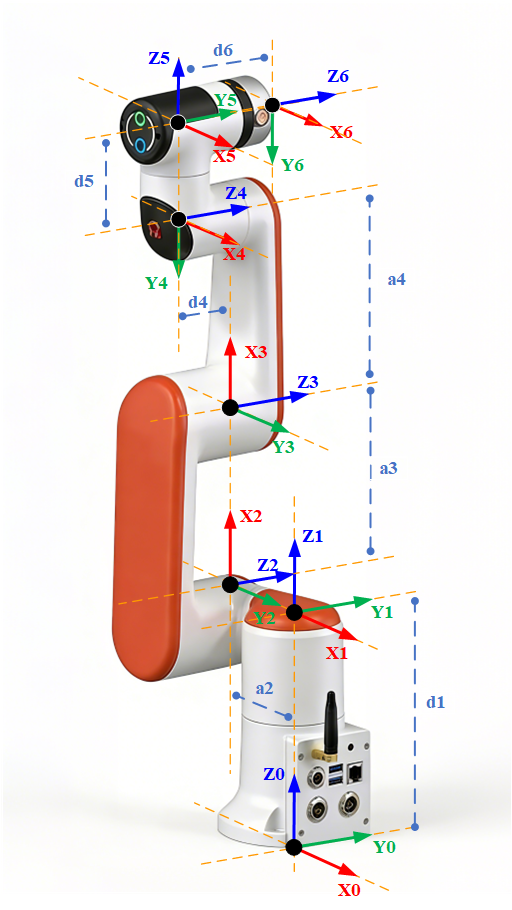
MDH parameters of ECO62-B (modified D-H parameters):
| Joint No.(i) | Remarks | ||||
|---|---|---|---|---|---|
| 1 | 0 | 0 | 136 | 0 | |
| 2 | -70 | -90 | 0 | -90 | |
| 3 | 148 | 0 | 0 | 0 | |
| 4 | 136 | 0 | -58.5 | 90 | |
| 5 | 0 | 90 | 71 | 0 | |
| 6 | 0 | -90 | 70.7 | 0 | (B) Standard End Effector (03 Joint Version) |
Kinetic parameters of ECO62-B robot link
| joint_id(i) | Remarks | ||||||||||
|---|---|---|---|---|---|---|---|---|---|---|---|
| 1 | 1341.83707 | -1141.53218 | 4.12154 | 3723.08113 | -0.70646 | 3980.45116 | -36.0000 | -13.4700 | -9.0800 | 1.19575 | |
| 2 | 1943.5495 | -1.2359 | -3235.9682 | 15599.5218 | -0.5731 | 14116.9907 | 119.8000 | 0 | -39.6000 | 0.8055 | |
| 3 | 185.576 | -2.1952 | -249.1234 | 5023.694 | -0.196 | 5034.4334 | 94.4000 | 0 | -2.0000 | 0.413 | |
| 4 | 166.6853 | -0.523 | -0.3532 | 73.6738 | -0.808 | 158.8891 | -0.1000 | -16.8000 | 3.4000 | 0.2386 | |
| 5 | 224.9708 | -0.662 | -0.3276 | 93.8259 | -0.5701 | 211.4858 | -0.1000 | 16.8000 | -4.3000 | 0.2633 | |
| 6 | 32.2687 | -0.0503 | -0.0155 | 31.9264 | -0.034 | 24.373 | 0 | -0.1000 | -14.6000 | 0.0667 | End flange |
Description:
is the mass of the link, is the x-coordinate of the center of mass of link, is the y-coordinate of the center of mass of link, is the z-coordinate of the center of mass of link, , , , , , is the principal moment of inertia described in the link frame,
Remarks:
- Source of data: CAD design values.
- If the inertial parameters in the center of mass frame are required, they can be calculated based on the parallel axis theorem, as stated below.
Assuming there is an output frame
Where,
Distribution and dimensions of joints
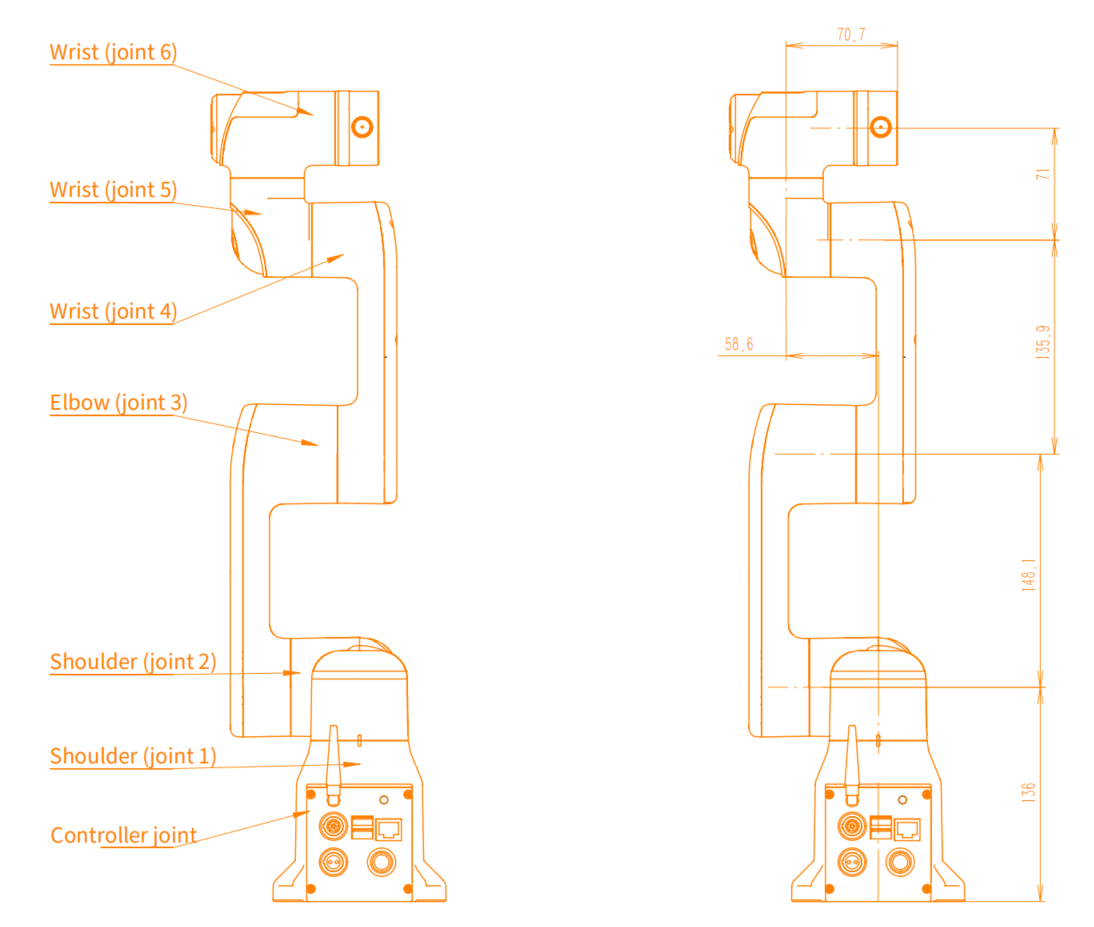
The ECO62 robotic arm has six rotating joints, each representing one degree of freedom. As shown in the figure below, the robot joints include the shoulder (joints 1, 2, and 3), the elbow (joint 4), and the wrists (joints 5 and 6).
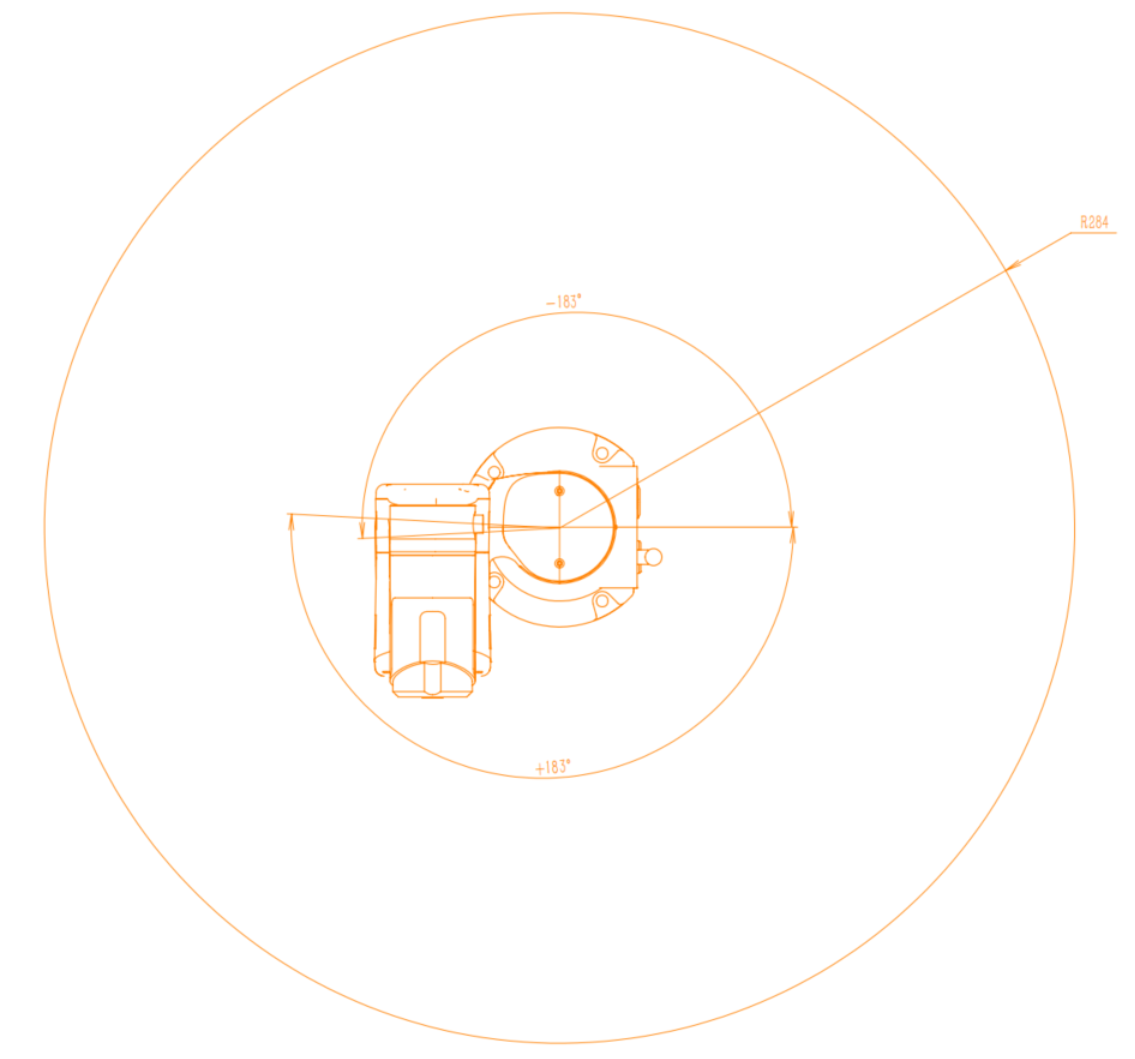
Workspace
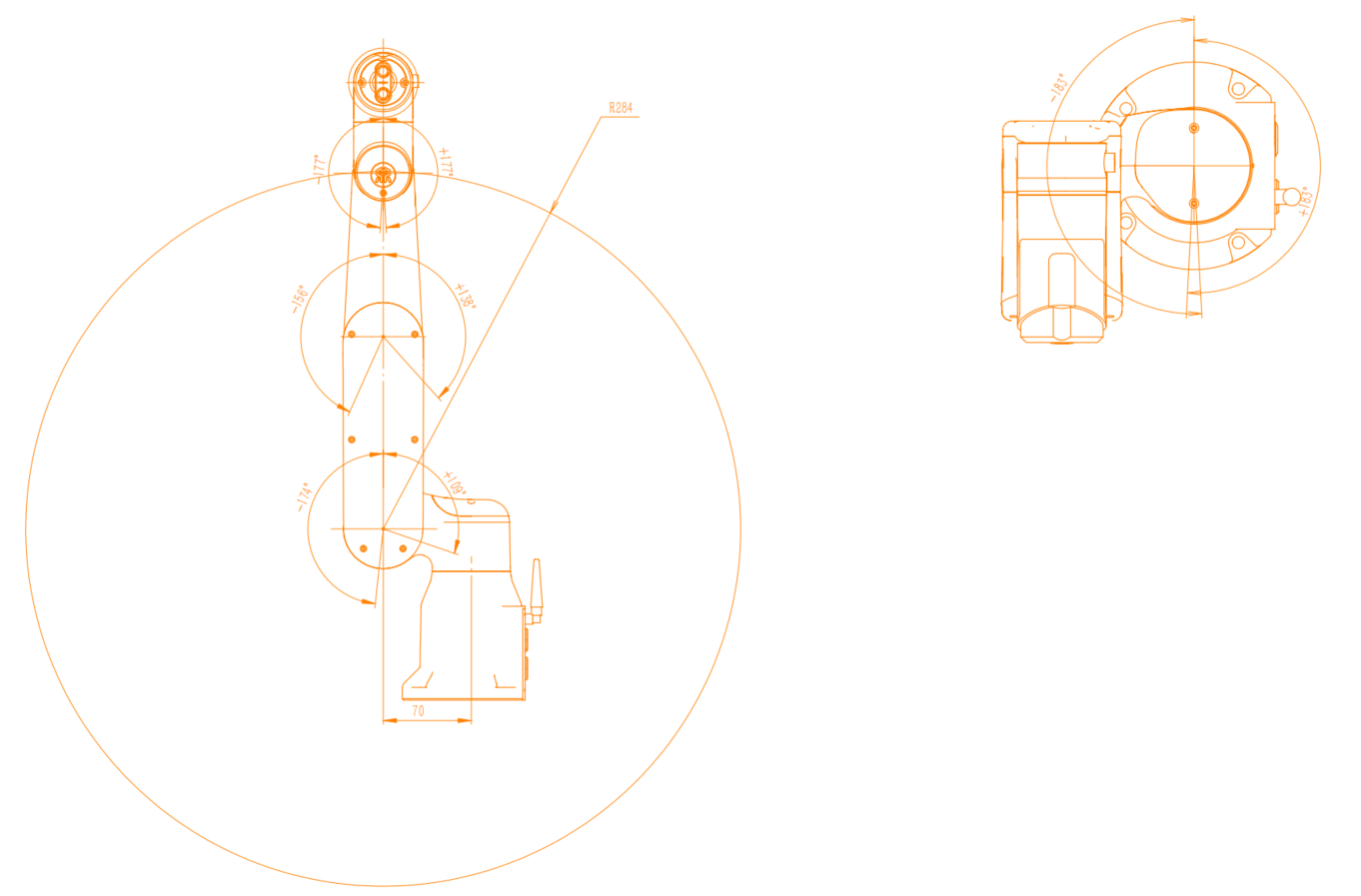
The workspace of ECO62 is a sphere with a working radius of 355 mm, excluding the cylindrical space directly above and below the base. When determining the installation position of the robot, due consideration must be given to the cylindrical space directly above and below the robot to avoid moving tools into this cylindrical space as much as possible. Furthermore, in actual applications, the motion ranges of all joints are as follows: Joint 1: ±178°; Joint 2: -169° to +104°; Joint 3: -151° to +133°; Joint 4: ±172°; Joint 5: ±172°; Joint 6: ±360°.
Motion singularities
Singular type 1: Shoulder singularity
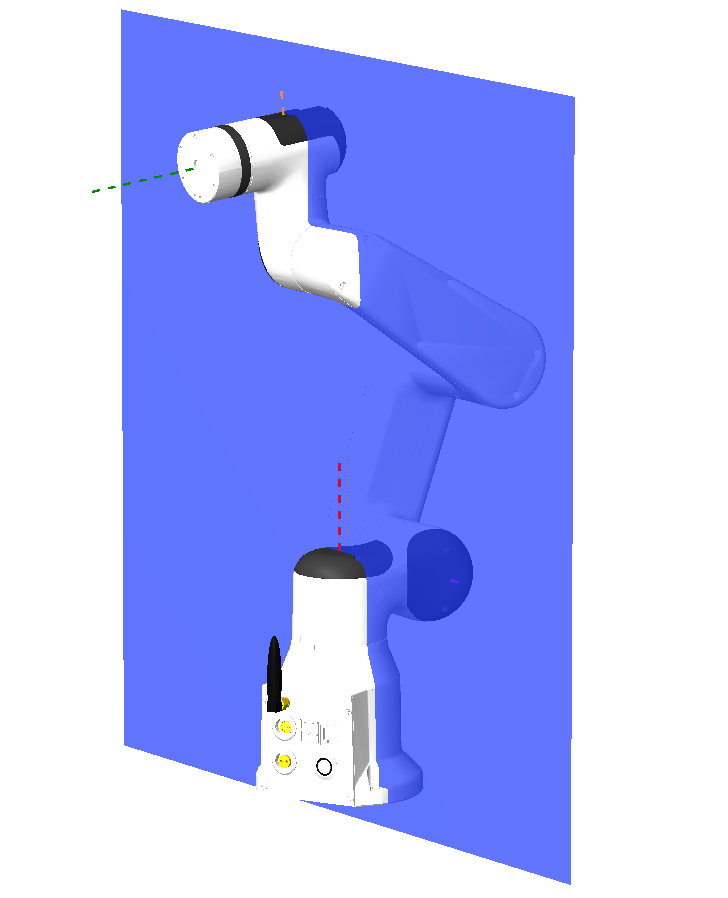
When the intersection point of the axes of Joint 5 and Joint 6 lies on the plane that passes through the axis of Joint 1 and is parallel to the axis of Joint 2, a shoulder singularity occurs.
The shoulder singularity is shown in the figure below. The blue plane in the figure is the plane that passes through the axis of Joint 1 and is parallel to the axis of Joint 2.
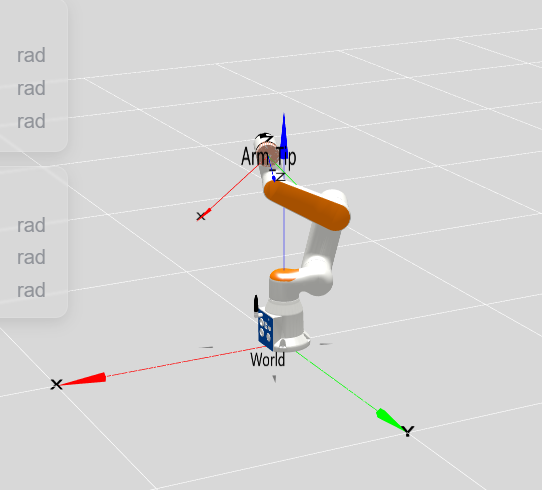
Example point 1: [-24.6,-13.199,77.911,-51.913,1.997,1.110], as shown in the figure below:
Singular type 2: Elbow singularity
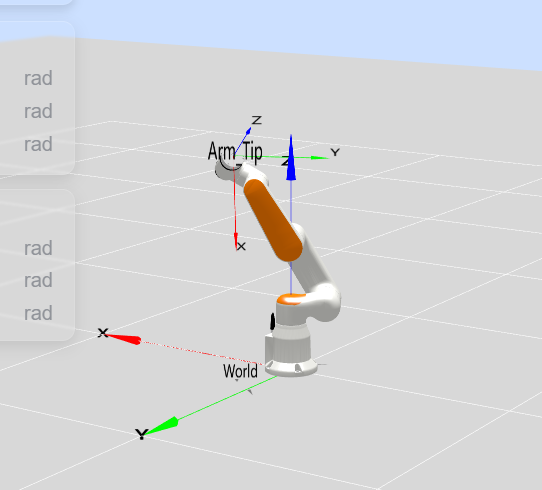
When the intersection point of the axes of Joint 5 and Joint 6 lies on the plane formed by the axes of Joint 2 and Joint 3, and q3=0, i.e., the point format is [x,x,0,x,x,x], an elbow singularity occurs.
Example point 1: [30,30,0,30,30,30], as shown in the figure below:
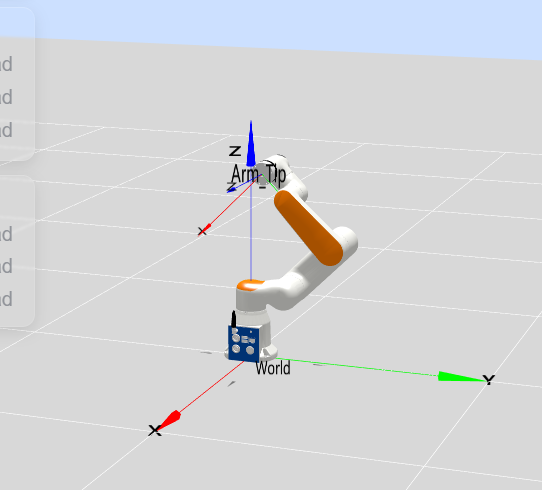
Singular type 3: Wrist singularity
When the axes of Joint 4 and Joint 6 are parallel, q5=0, i.e., the point format is [x,x,x,x,0,x], a wrist singularity occurs.
Example point 1: [-90,-45,90,0,0,0], as shown in the figure below:
Singular type 4: Boundary singularity
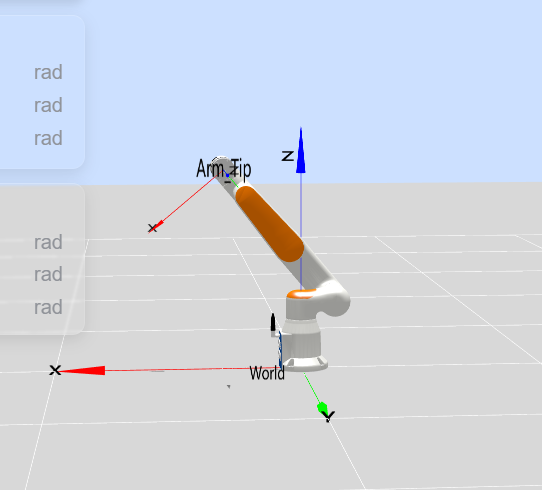
When the robot end-effector reaches the farthest point, q3=0 and q5=0, i.e., the point format is [x,x,0,x,0,x], a boundary singularity occurs.
Example point 1: [0,40,0,0,0,0], as shown in the figure below:
Load curves
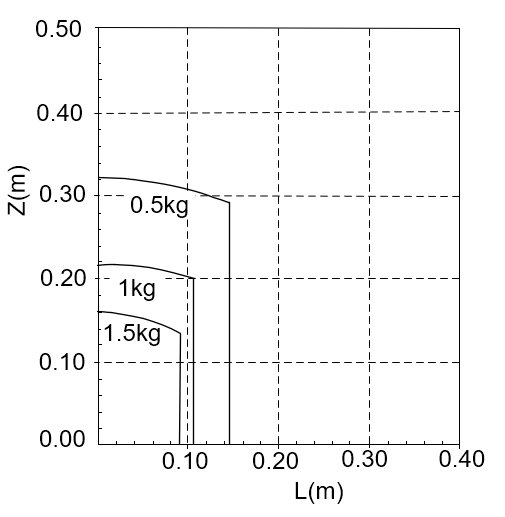
The following figure represents the end load curve of the ECO62-B robotic arm. Here, L refers to the radial distance of the end load's center of mass relative to the end flange plane, and Z refers to the normal distance relative to the end flange plane.